The impact of technology on the next generation of agricultural professionals – one of the key topics at the Agriculture 4.0 Symposium, organized by World Vision Romania and BNP Paribas Leasing Solutions
- 50% of agricultural employees struggle to find qualified workers;
- More than half of students attending agricultural high schools did not initially want to enroll in such schools. Yet 84% said they were satisfied with the education they had received;
- New professions in agriculture as a result of technology;
- A solid career in agriculture requires three key elements: theoretical knowledge, practical experience and digital skills.
Agriculture 4.0, which integrates advanced technologies such as Artificial Intelligence, the Internet of Things (IoT), sensors and robots is increasing the demand for professionals who combine agricultural knowledge with digital skills, said Andreea Țundrea, Operations Manager at World Vision Romania, during “The Agriculture 4.0 Symposium”, an event organized by World Vision Romania and BNP Paribas Leasing Solutions in Iași, from 12 to 14 November.
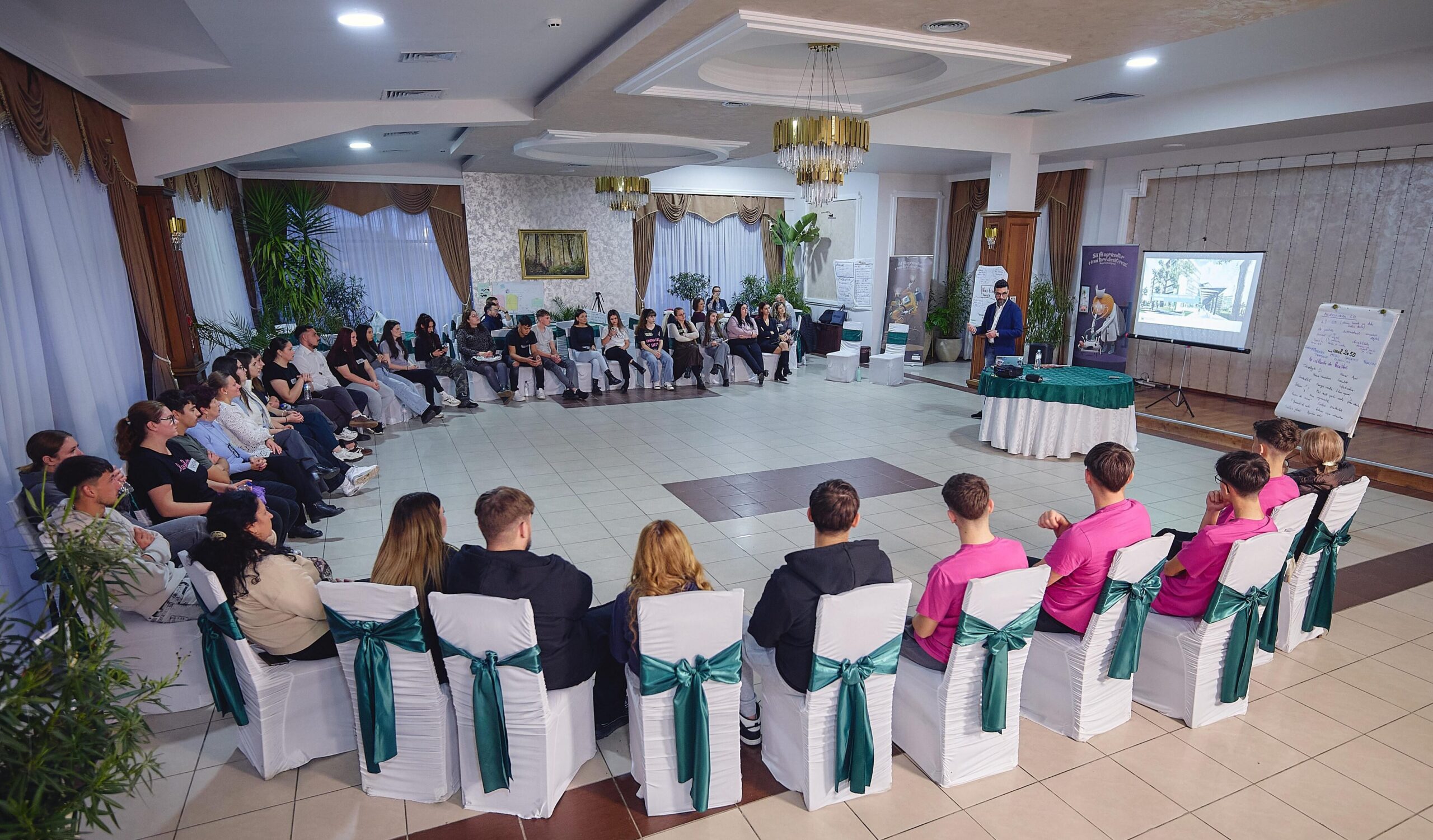
“The Agriculture 4.0 Symposium” brought together 50 students and teachers from seven agricultural high schools, as well as representatives of academia and the agribusiness sector, to discuss the transformations in agriculture and the skills that future professionals will need. To gain experience, during the event, the students took part in a field trip to Universitatea de Științele Vieții „Ion Ionescu de la Brad” (University of Life Sciences “Ion Ionescu de la Brad”) in Iași, where they toured the greenhouse, the mechanization and food industry laboratories, watched practical demonstrations, and, together with professors and researchers, explored career opportunities after high school graduation.
The event was organized as part of “Mândru să fiu fermier” (Proud to be a farmer), an agricultural education programme run by World Vision Romania to bring students closer to modern agriculture and strengthen the links between schools, universities and the agribusiness sector.
New professions in agriculture as a result of technology
“The agricultural sector faces the challenge of attracting and retaining workers, but above all, a shift in the skills required. The use of artificial intelligence, robotics, drones, and other new technologies can increase the demand for digitally skilled workers. Currently, a solid career in agriculture must combine three components: theory, practice, and digital skills. At the same time, modern agriculture offers much more diverse professional opportunities than those traditionally associated with the sector”, said Andreea Țundrea, Operations Manager at World Vision Romania.
She added that experience with the soil, plants, animals, and local conditions remains fundamental, but Agriculture 4.0 builds on tradition through new tools; as a result, decisions that were previously based solely on human expertise are now supplemented by data and smart technologies.
According to World Vision Romania, graduates of agricultural high schools can pursue careers such as: crop monitoring technicians using drones and sensors; veterinary technicians working in automated farms; specialists in plant protection, soil science, sustainable agriculture, the food industry and food quality control; agricultural equipment maintenance and automation technicians; operators of smart agricultural machinery and precision farming equipment; entrepreneurs or managers in the agricultural sector.
“We are convinced that the future of agriculture depends on our ability to combine tradition with digital innovation. By supporting the project «Mândru să fiu fermier» (Proud to be a farmer), BNP Paribas Leasing Solutions is taking on the responsibility of not only financing modern equipment but also investing in human capital. Moreover, the digitization of agriculture creates a paradox: we have access to the most advanced technologies, but the market faces a shortage of qualified personnel to operate them. This is why supporting agricultural education is a priority. Integrating digital skills into the curriculum is essential to bridge the gap between the theory taught in high schools and the realities of agribusiness. Investing in the training of young people is the only way to ensure that equipment technologies will be used to their full potential on farms in Romania,” said Philippe Desgeans, Country Manager at BNP Paribas Leasing Solutions.
50% of agricultural employees struggle to find qualified workers
More than 50% of agricultural employers face a shortage of qualified workers, while 75% of companies are interested in collaborating with agricultural high schools to help train students, according to a study published in 2025 by the Romanian Centre for European Policies in partnership with the Ministry of Agriculture and Rural Development.
Despite the growing demand for agricultural professionals, only 25% of students attending agricultural high schools want to work or start a business in this sector, while 48% are still considering this possibility, according to a 2025 World Vision study. However, although 53% of respondents said they would have preferred to attend a different type of high school, by the end of Grade 12, 84% said they were satisfied with what they had learned.
“The Agriculture 4.0 Symposium” is part of “Mândru să fiu fermier” (Proud to be a farmer), a programme run by World Vision Romania to transform agricultural high schools into modern learning and experimentation environments, adapted to contemporary agriculture and labor market requirements. The programme connects agricultural high schools with the business community by organizing study visits to modern farms, developing work-based learning models for students and supporting campaigns to promote agricultural high schools.
Since the launch of “Mândru să fiu fermier”in 2015, World Vision Romania has invested more than USD 1 million in agricultural education. Through the programme, more than 150 teachers and 7,500 students from over 40 agricultural high schools have benefited from new facilities and a modernized curriculum. As part of the programme, students also use the educational resource package Journey to 2050, which includes 12 lessons exploring the future of agriculture.
In implementing “Mândru să fiu fermier” programme, World Vision is part of the Growing through Agricultural Education (CEA) consortium, alongside the Romanian Centre for European Policies (CRPE), Civitas Foundation for Civil Society and Junior Achievement Romania (JA), with the support of the Romanian-American Foundation (RAF).